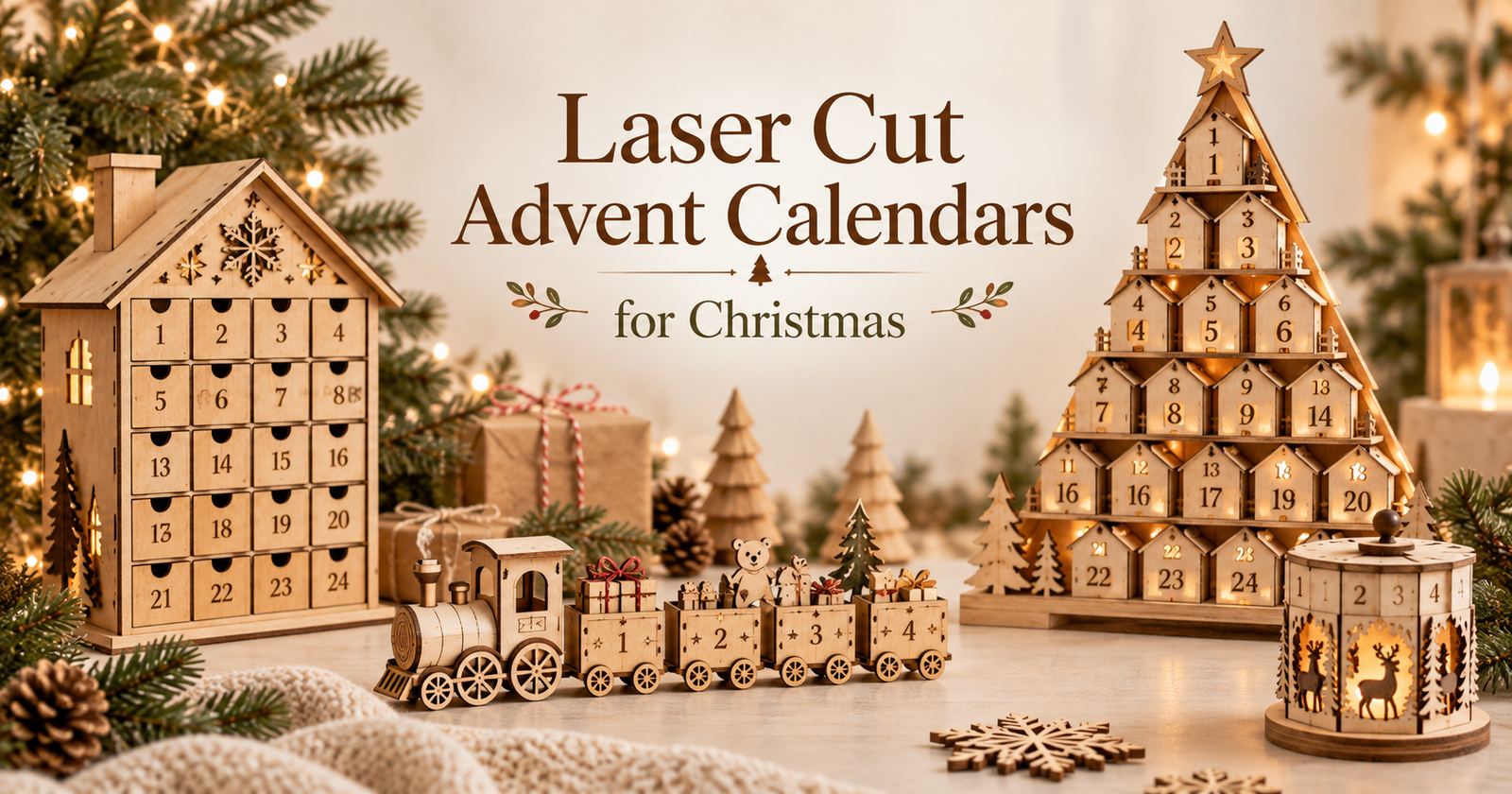
10 Laser Cut Advent Calendars Worth Making for Christmas
Laser cut Advent calendars are one of those Christmas projects where the construction matters almost as much as the design. A simple rotating countdown can be finished fairly quickly; a tree made from 25 individual wooden houses is a completely different weekend project.
For this list, I looked for files that actually give you different ways to count down to Christmas — houses, drawers, moveable markers, wall-mounted designs and more involved 3D builds. I also paid attention to the information in the listing. Material thickness, finished size and a few clues about assembly are much more useful than a polished mockup when you’re deciding what you really want to make.
Some of these calendars are meant to hold candy or small gifts. Others are simply reusable countdown decorations. The right choice depends on how much cutting and assembly you want to do, how much space you have, and whether you need 24 little hiding places at all.
Advent Calendars with Houses and Compartments
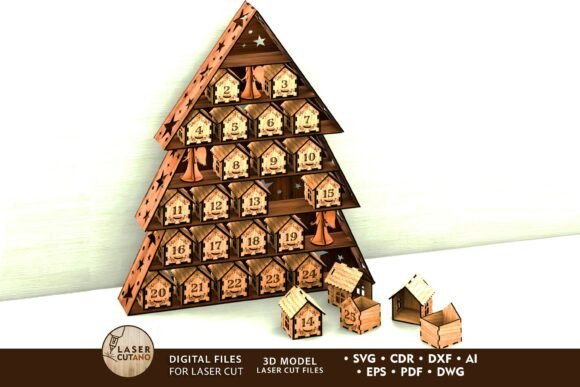
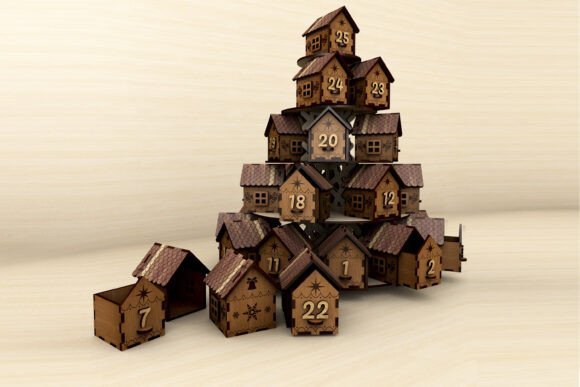
1. Christmas Advent Calendar Tree
This is the project I’d choose if the Advent calendar itself is supposed to become part of the Christmas decor.
It uses 25 individual miniature houses arranged into the shape of a Christmas tree. Each house has an engraved number and enough space for a small treat or surprise. The complete structure is substantial — about 663 × 450 mm (26 × 17.7 inches) — so this isn’t a tiny tabletop countdown disguised by a clever product photo.
The designer specifies 3 mm / 1/8-inch material and suggests plywood, MDF or acrylic. Individual houses are approximately 53 × 56 × 70 mm, and the structure uses a slot-fit assembly rather than glue. The download includes SVG, DXF, AI, CDR, PDF, EPS and DWG files.
I like this one because the 25 houses are actually part of the visual idea. Once Christmas is over, though, you’ll need somewhere to store a fairly large object.
2. Christmas Advent Calendar — Individual House Set
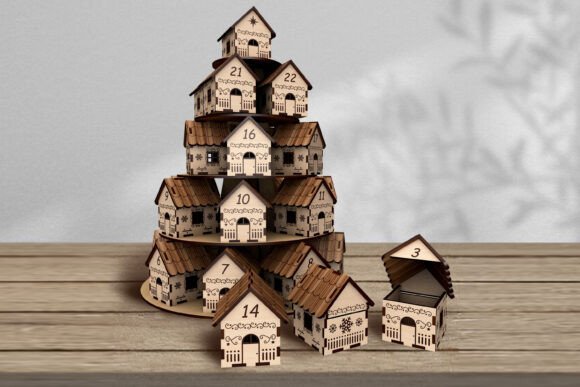
This one takes a more flexible approach. Instead of locking all the compartments into one fixed structure, you get separate numbered houses.
Each finished house measures roughly 70 × 75 × 65 mm, and the design is intended for 3 mm material. The listing suggests plywood, MDF, acrylic or wood and includes AI, SVG, DXF, DWG, CDR, EPS and PDF files.
The useful part is that you can arrange the houses however you like. Put them across a mantel, build a little village, or group them under a tree.
3. Days Until Christmas Advent Calendar
This is another house-based calendar, but I’d pick it over a fixed structure if you want to change the display from year to year.
The houses are again about 70 × 75 × 65 mm, designed for 3 mm material. What makes the project more interesting is the flexibility: the listing specifically suggests arranging the houses in a line, in a tree shape, on the included stand or in your own configuration.
That sounds like a small difference, but it matters when you actually live with the calendar for a month. A modular set is easier to fit around whatever other Christmas decorations you already have.
Interactive Christmas Countdown Calendars
4. Christmas Countdown Calendar with Moveable Star
Not everyone needs 24 boxes.
This layered calendar replaces the compartments with a numbered ring from 1 to 25. You simply move the star as Christmas gets closer. The design includes Santa, a reindeer and a Christmas tree, so it still reads immediately as a holiday piece rather than a generic number board.
One practical advantage is material flexibility. The listing is prepared for 3 mm, 3.2 mm, 4 mm and 4.2 mm thicknesses, and the download includes SVG, DXF, AI, EPS, PDF, CDR and DWG files.
If you want a reusable family countdown but don’t actually care about hiding chocolate in 24 tiny drawers, this is probably the more sensible project.

5. Small Wall-Mounted Rotating Advent Calendar
This is the compact option.
The listing describes it as a small wall-mounted rotating Advent calendar that is easy to assemble and compact to store, with the largest part measuring about 28 cm / 11 inches.
That makes it much easier to live with than a 26-inch wooden tree. It also solves one of the less glamorous problems with seasonal laser projects: where you put them in January.
I’d choose this if storage matters or if you want something that can hang on a wall instead of taking over a table or mantel.
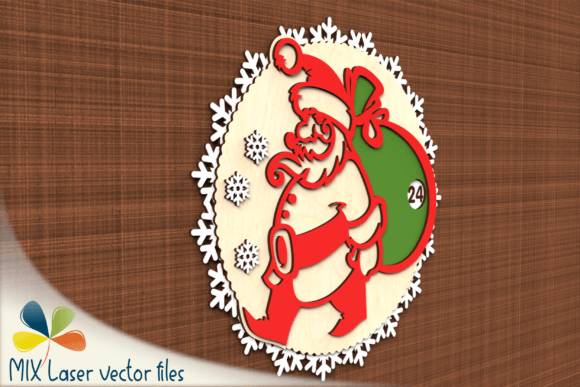
6. Christmas Countdown Advent Calendar
This is a more traditional layered calendar, but the listing gives enough technical information to know what you’re getting.
The finished size is approximately 13 × 9 inches, the project includes engraving, and it is designed around 3 mm material. Suggested materials include plywood, MDF, acrylic, Plexiglas, metal and even cardboard. The download contains AI, SVG, DXF, DWG, CDR, EPS and PDF formats.
It’s less dramatic than the tree or village projects, but that can be an advantage. If you want a recognizable Advent countdown without dozens of separate parts, this is easier to justify.
More Involved Advent Calendar Builds
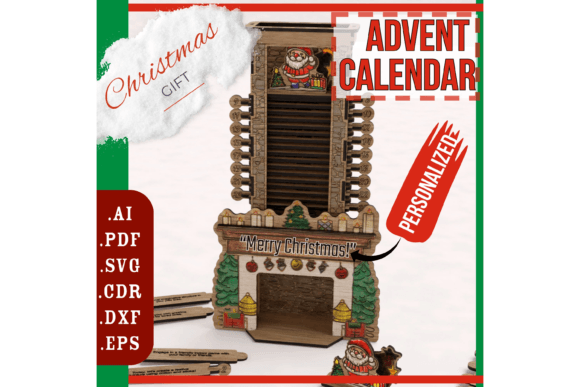
7. Santa in the Chimney Advent Calendar
This is one of the more interesting designs in the list — and also one I wouldn’t recommend as a first laser project.
Instead of drawers, it uses 24 slide-out platforms, each approximately 90 × 20 mm. The finished calendar measures around 293 × 165 × 100 mm, is designed for 3 mm / 1/8-inch material, and can reportedly be cut from four 11.8 × 7.9-inch sheets. The download includes SVG, DXF, EPS, AI and CDR files.
There’s also a useful real-world warning in the review section. One verified purchaser said the file worked beautifully after changing the cut style, but ended up with a lot of pieces and wasn’t sure how to assemble them.
That doesn’t make it a bad file. It just means this is the kind of project where I’d study every listing image before pressing Start.
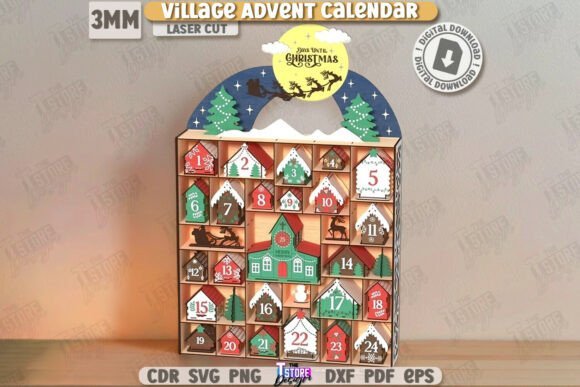
8. Christmas Village Advent Calendar
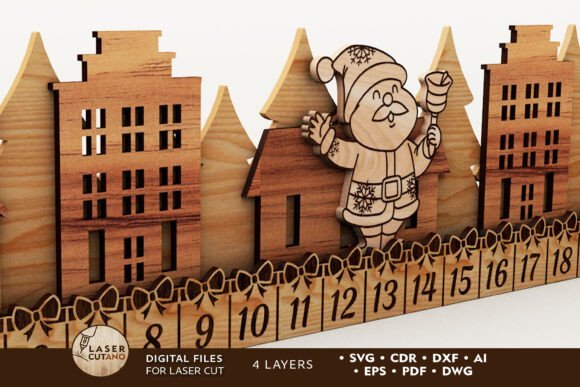
If the tree calendar is the centerpiece option, this is the more detailed village alternative.
The product contains 27 SVG, EPS, PNG, PDF and DXF files, with the listing clearly marking red lines as CUT and black lines as ENGRAVE. It also includes a LightBurn-specific note recommending DXF if SVG imports with distorted dimensions.
I like that kind of technical note because it answers a real problem instead of just saying the design is “perfect for laser cutting.”
This would be my pick for someone who enjoys assembly and wants the Advent calendar to look like a miniature Christmas display, not simply a countdown board.
9. Christmas Gift Box Advent Calendar
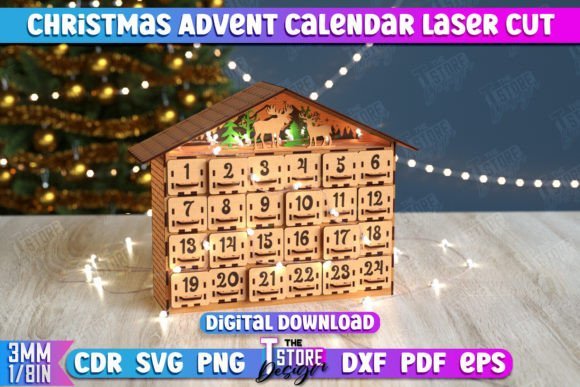
This is a simpler box-style design and a good middle ground between a flat countdown and a large house village.
The download includes SVG, EPS, PNG, PDF and DXF files. The listing explicitly separates CUT and ENGRAVE lines and again warns that LightBurn can sometimes distort SVG dimensions, suggesting DXF as the safer alternative when that happens.
I’d look at this one if the real purpose of your Advent calendar is putting something behind each day. The box format is less theatrical, but more practical.
10. Christmas Train Advent Calendar
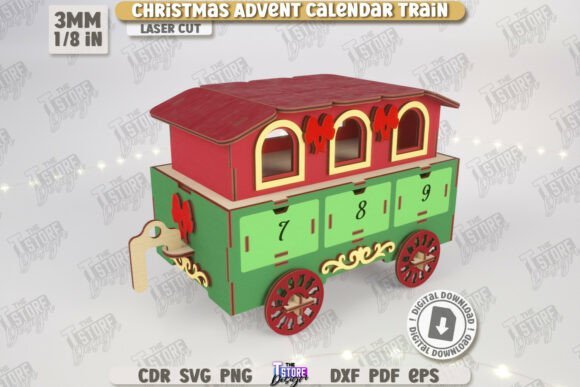
A train is a much more playful way to build an Advent calendar, especially if the finished project is for children.
The version I found uses a North Pole Express-style train and includes SVG, EPS, PNG, PDF and DXF files. As with several files from this designer, red lines indicate CUT and black lines indicate engraving, with the same recommendation to try DXF in LightBurn if SVG dimensions import incorrectly.
This isn’t the calendar I’d choose if I wanted the simplest build. I’d choose it because a Christmas train is fun enough to stay out as decoration even after the daily countdown has stopped being the main attraction.
How to Choose Laser Cut Advent Calendars
Before choosing a file, decide what you actually want the calendar to do.
If you want to hide sweets, notes or tiny gifts every day, you need real compartments. The house sets and box-style calendars make sense for that.
If the ritual is more important than the surprise inside, a moveable star or rotating calendar is easier to build, easier to store and still gives children something physical to change every day.
And if the project itself is the attraction, go for the tree, train or Christmas village. Those are less about convenience and more about making something that becomes part of the holiday display.
What Material Should You Use?
A lot of the designs in this guide are built around 3 mm / roughly 1/8-inch material, but don’t treat that as a universal rule.
Slot-fit construction is particularly sensitive to thickness. A file designed for 3 mm plywood may fit poorly if your actual sheet is 3.4 mm, even if the shop label says “3 mm.”
Measure the material you actually have with calipers before starting a large build.
Plywood is the obvious choice when you want a natural wooden finish. MDF is predictable and easy to paint. Acrylic works well for modern designs, but it changes both the look and the assembly.
How Much Time Do You Want to Spend Assembling It?
This is the question product mockups rarely answer.
A rotating wall calendar may only have a handful of parts. A 25-house tree has 25 separate miniature structures before you even assemble the tree itself.
Neither is inherently better.
For a first Advent calendar, I’d choose something compact with fewer fitted pieces. Once you know how accurately your machine cuts the material you normally use, a village or house set becomes much less intimidating.
For bigger builds, I’d also open the downloaded files and identify every part before cutting an entire sheet. A successful cut does not automatically mean an obvious assembly.
More Christmas Laser Cut Projects
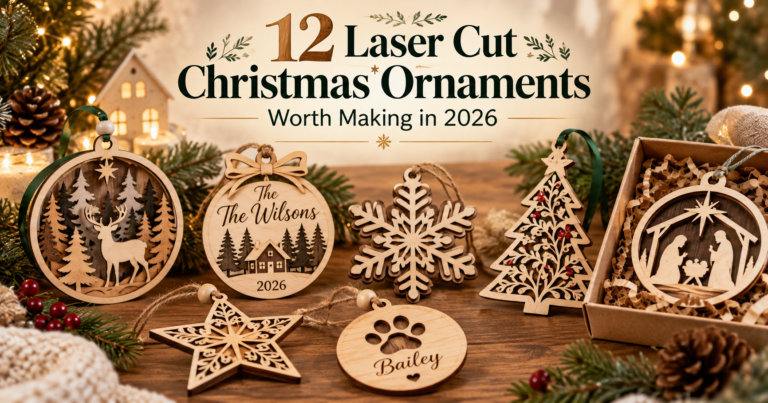
If you want something smaller before committing to an Advent calendar, start with our guide to 12 Laser Cut Christmas Ornaments Worth Making in 2026. Ornaments use less material and are an easier way to test layering, engraving and personalization.
If you want to explore beyond ornaments and calendars, our broader guide to 15 Best Christmas Laser Cut Files & Projects for 2026 includes lanterns, light boxes, Nativity scenes, gift packaging and other seasonal projects.
An Advent calendar is a bigger commitment than an ornament, but that’s also why a good one is worth making. Once it’s finished, it can come back out every December instead of disappearing into a box after one Christmas.